Why Use CRC Crick 120 Penetrant?
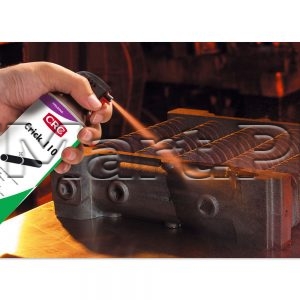
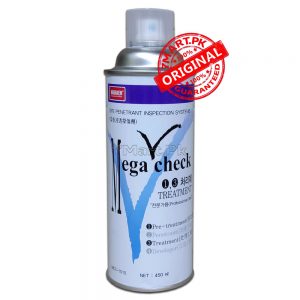
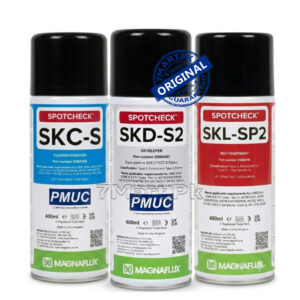
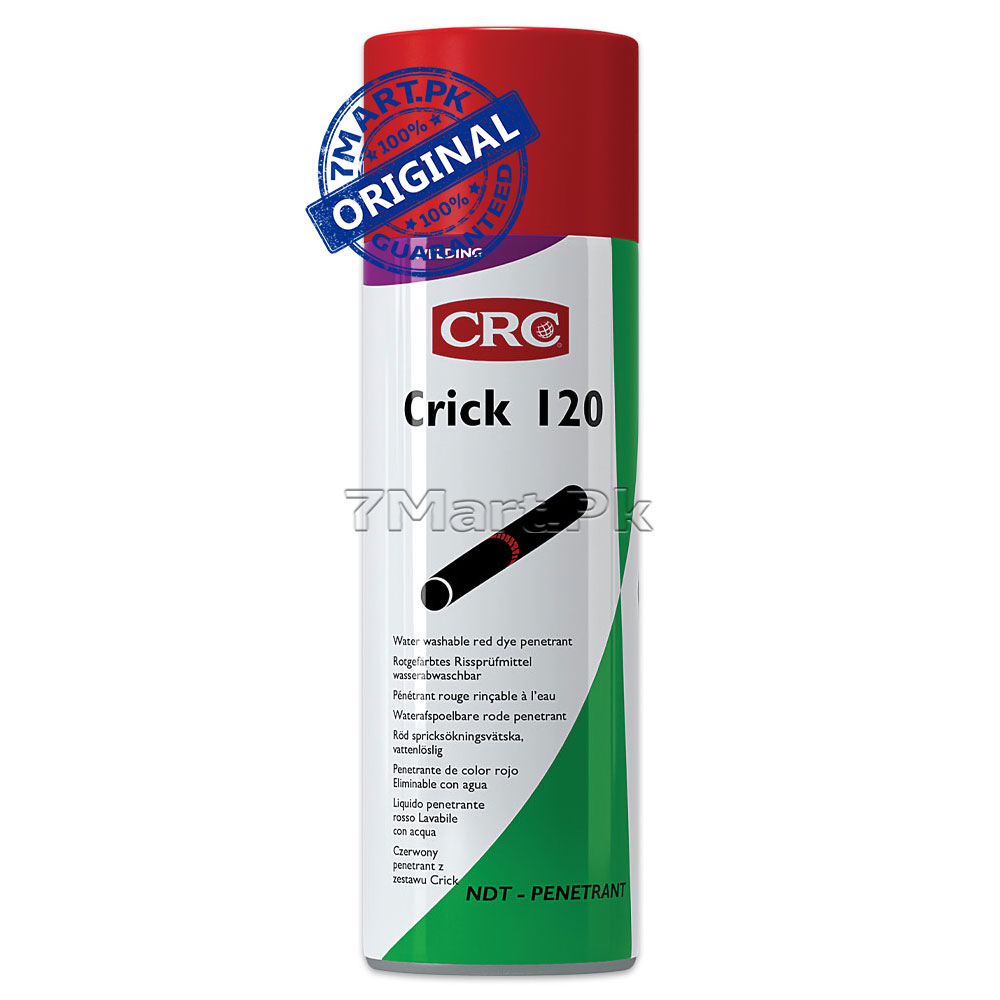
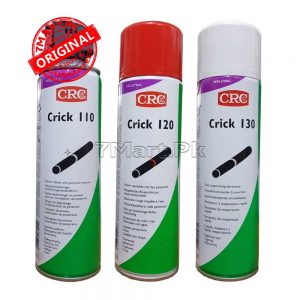
CRC Crick 120 is a water-washable red penetrant designed for professional non-destructive testing (NDT) of metal, ceramic, and engineered components. It helps inspectors detect extremely fine surface-breaking defects that may not be visible during normal visual inspections. As the second step of the CRC Crick three-stage inspection system—used with CRC Crick 110 Cleaner and CRC Crick 130 Developer—it delivers accurate and reliable flaw detection without damaging the test material.
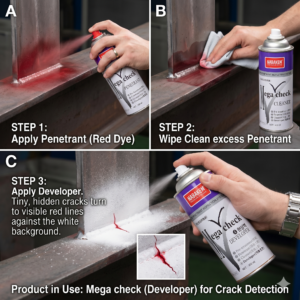
The bright red dye penetrates tiny surface openings, including cracks, pores, and fatigue fractures. As a result, hidden defects become visible after the developer is applied, allowing maintenance teams to identify problems before they lead to equipment failure. Furthermore, the water-washable formula makes excess penetrant easy to remove, simplifying the inspection process while maintaining high sensitivity.
CRC Crick 120 Features
- Water-washable visible red penetrant
- Designed for non-destructive testing (NDT)
- High-sensitivity defect detection
- Easy aerosol application
- Works with CRC Crick 110 Cleaner and Crick 130 Developer
- Suitable for various metals and engineering materials
- Economical inspection method without expensive equipment
- Halogen content tested according to ASME Section V, Article 6
CRC Crick 120 Benefits
CRC Crick 120 improves inspection accuracy by revealing cracks and surface defects that are difficult to detect with ordinary visual methods. In addition, its ready-to-use aerosol saves preparation time and improves inspection efficiency. Consequently, manufacturers and maintenance professionals can identify potential failures early, reducing repair costs and improving equipment safety. Moreover, the water-washable formula speeds up cleaning after inspection.
CRC Crick 120 Applications
CRC Crick 120 is suitable for welded joints, castings, forgings, pipelines, pressure vessels, boilers, tanks, heat exchangers, structural steel, engineering components, machinery parts, fabricated metal structures, ceramics, and industrial equipment. It effectively detects cracks, porosity, lack of fusion, laps, folds, leaks, cavities, and fatigue-related defects.
How to Use CRC Crick 120
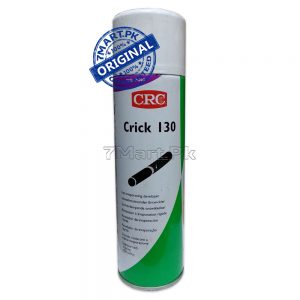
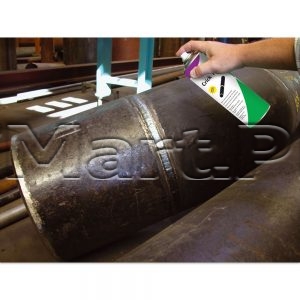
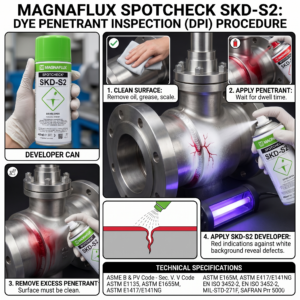
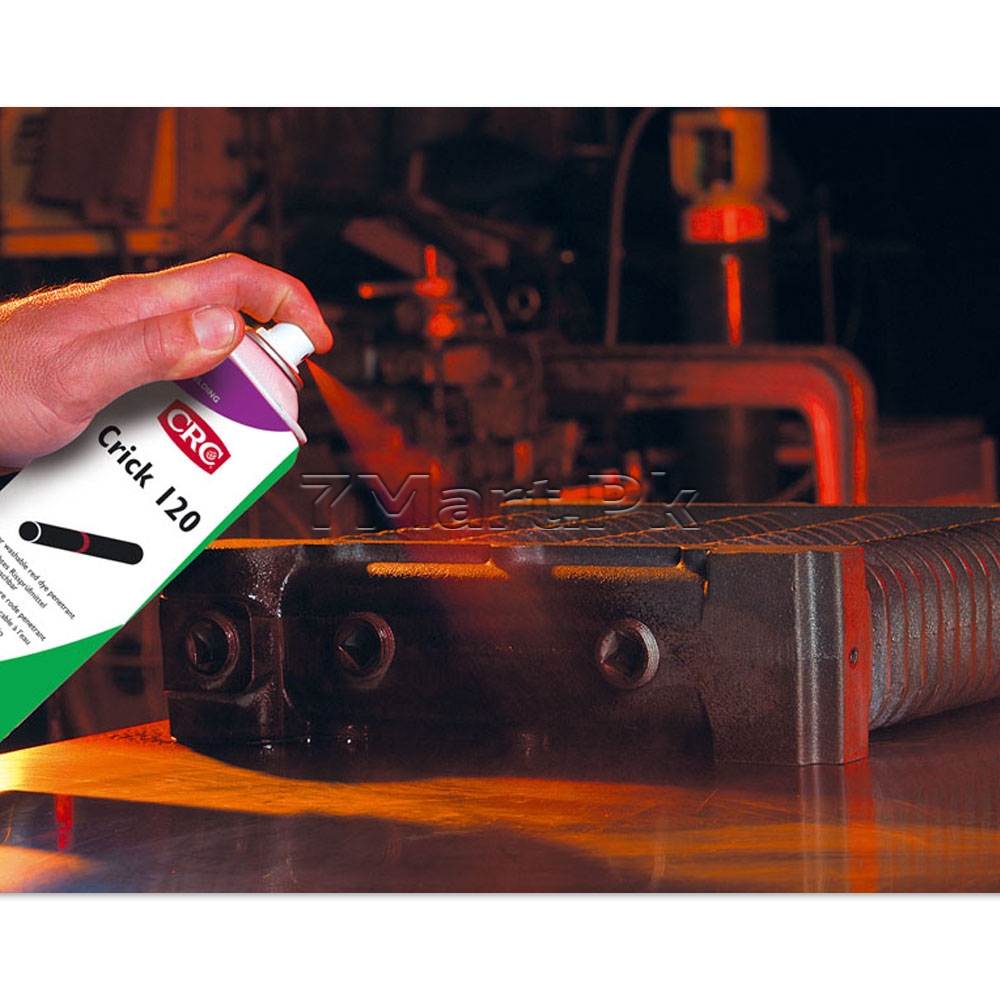
First, clean the test surface thoroughly using CRC Crick 110 Cleaner to remove grease, rust, dirt, paint, and other contaminants. Next, shake CRC Crick 120 well and apply a light, even coat over the inspection area. Allow the penetrant to dwell for 10–20 minutes so it can enter any surface defects. Afterwards, remove excess penetrant with water while ensuring penetrant inside the defects remains untouched. Dry the surface completely before applying CRC Crick 130 Developer, which will draw the penetrant from defects and make them clearly visible.
Overall, CRC Crick 120 provides a fast, economical, and highly reliable solution for professional liquid penetrant inspections. Therefore, it is widely used in welding, manufacturing, maintenance, quality control, and industrial inspection to ensure component safety and structural integrity.